A standalone workshop, participatory event or continuing programme.
Applied improvisation for communities
Create connection, shared joy and room for every voice.
A welcoming, participatory session where people can connect through play, create together and discover how much becomes possible when nobody has to arrive with a perfect answer.
The structure adapts to group size, access needs and familiarity.
Community context, duration, preparation and location are considered.
Italian available; German by agreement.
Connection through shared play
A community does not need to agree on everything to create something together.
Community rooms often bring together different cultures, confidence levels, ages, languages and reasons for being there. Play can create a shared point of contact before everyone knows each other well.
Since 2017, I have facilitated English-language improvisation in Munich with beginners, experienced improvisers and international groups. I build challenge gradually so that contribution is invited rather than demanded.
The session can focus on connection, creativity, communication or simply the experience of making something together. The activities are playful, but the welcome, consent and group care are taken seriously.
Shared joy is not an escape from difference. It can be one way a group learns to stay curious about it.
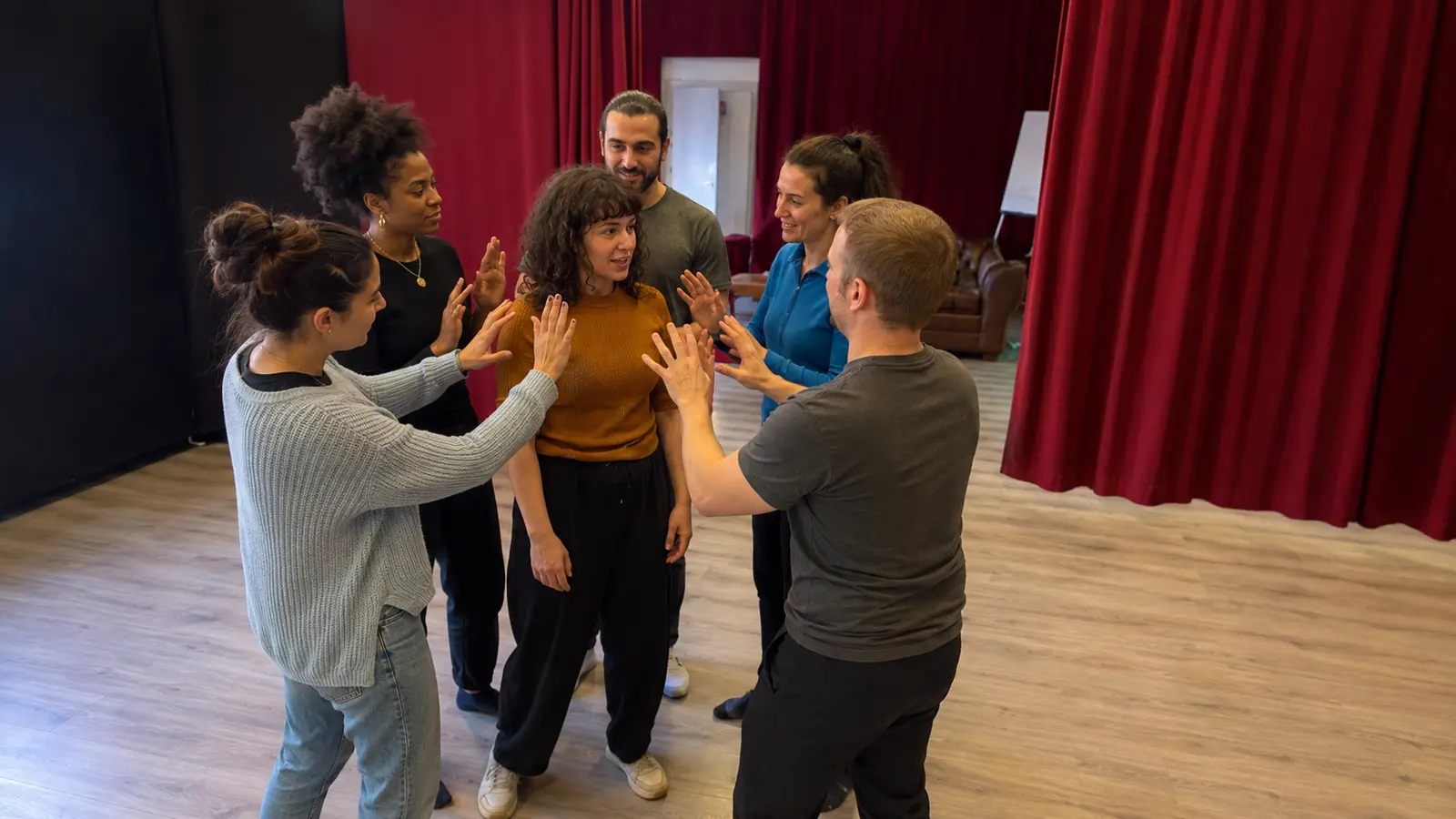
Connection begins with shared attention.A common focus gives different people a low pressure way to enter the room and contribute.
What participants can practise
Observable behaviours, not abstract promises.
Enter the room more easily
Use simple shared activity to reduce the pressure of introducing yourself in an impressive way.
Notice and include
Practise receiving offers, making space and helping another person contribute.
Create shared joy
Experience laughter and surprise as something the group produces together rather than consumes.
Stay open to difference
Build with contributions that are not the ones you expected or would have created alone.
How it is designed
From your context to useful practice.
The content is tailored, but the design logic remains clear.
- 01
Understand the community
We discuss who the group is, why it gathers, what languages are present and what would make participation easier.
- 02
Shape the invitation
The framing explains what will happen, what is optional and why the activities fit the occasion.
- 03
Build connection gradually
The sequence moves from low-pressure shared attention towards richer group creation.
- 04
Close with what mattered
Reflection can be light or more deliberate, depending on whether the purpose is social, cultural or educational.
Where it fits
Useful starting points.
- International and intercultural communities looking for a shared English-language activity
- Cultural centres, associations and public programmes seeking participatory workshops
- Groups that want to welcome newcomers and strengthen connection
- Community events that want people to create together rather than only watch
Responsible boundaries
What I will not oversell.
- No participant is required to perform alone, disclose personal experiences or be funny.
- Touch, direct eye contact and high-energy movement are never treated as universal requirements.
- The session does not use stereotypes about culture, language, disability, identity or social status as comedy material.
- Accessibility, room limits, supervision and photography expectations are discussed with the organiser in advance.
Practical questions
Before you put it in the programme.
Format, group size and context matter. These answers provide a starting point.
Can complete beginners participate?
Yes. The entry is designed for people with no improv or theatre experience, and challenge increases gradually.
Can the group include different English levels?
Often yes. I use demonstrations, physical options and simple instructions, then adapt the verbal complexity to the group. We should discuss the language mix before confirming the design.
Can this be part of a festival or public programme?
Yes. A shorter participatory session or a longer workshop can be designed around the programme, venue and expected flow of participants.
Do you provide a venue?
I can advise on room requirements and work with the organiser's venue. Venue hire is agreed separately unless it is explicitly included in a proposal.
Start with the situation
What should people do differently after the session?
Tell me about the audience, the recurring pattern and the time available. I will suggest a suitable design—or tell you if this is not the right format.