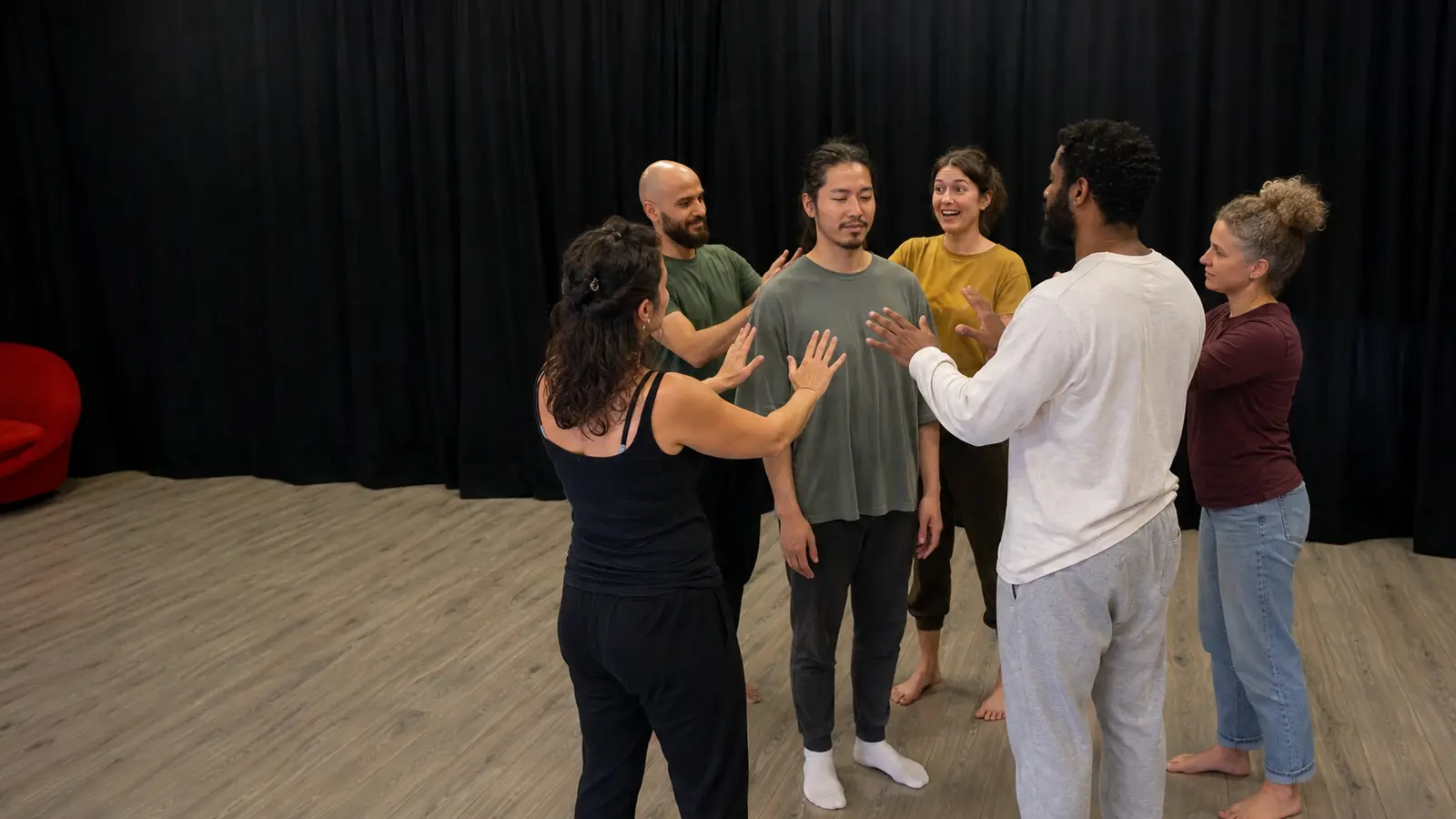
Workshop themes

Practise the way you want to work.

Interactive sessions for teams, leaders and events—designed around a behaviour you want people to experience, not just discuss.

Discuss your context

Choose a starting point

Eight ways into better collaboration.

These are not fixed packages. Each theme becomes a tailored sequence based on the group, time available and desired outcome.

01

Deep Listening & Presence

A concern is still being explained while three people prepare solutions. The meeting moves quickly, but the original risk is never fully received.

Participants practise
Listening to the complete offer, separating observation from interpretation and responding to one specific detail.
Possible outcomes
Conversations with fewer assumptions, more useful questions and clearer follow-through.
Suitable for
Teams, leaders, client-facing groups
Typical duration
2–3 hours
02

Co-Creation: Building on Ideas

A brainstorm becomes a sequence of competing mini-pitches. Each person protects an idea, but nobody develops what another person started.

Participants practise
Receiving an unfinished idea, adding something useful and letting ownership move around the room.
Possible outcomes
Ideas that develop faster, attract more contributors and feel less dependent on who suggested them first.
Suitable for
Innovation, product and project teams
Typical duration
2–3 hours
03

Collaboration Across Functions

Business, technology, finance and vendors bring valid but incompatible views. Everyone reports progress; the end-to-end picture remains unclear.

Participants practise
Making information usable to another function, connecting contributions and checking the shared picture.
Possible outcomes
Better handovers, earlier visibility of dependencies and clearer cross-functional decisions.
Suitable for
Business, technology and vendor teams
Typical duration
Half day
04

Adaptability Under Uncertainty

A dependency moves or an assumption breaks. The team either defends the original plan or waits for certainty that will not arrive.

Participants practise
Acknowledging what changed, using what is still available and choosing the next safe, workable move.
Possible outcomes
Less defensive reaction to change and more confidence in making progress without pretending uncertainty has disappeared.
Suitable for
Transformation and change teams
Typical duration
2–3 hours
05

Communication & Stakeholder Alignment

People leave the same meeting using the same words but carrying different assumptions about the decision, ownership and next step.

Participants practise
Reading the room, clarifying intent, making a message usable and checking what actually landed.
Possible outcomes
Fewer false agreements, clearer commitments and earlier discovery of misalignment.
Suitable for
Programme, architecture and delivery groups
Typical duration
Half day
06

Creative Confidence

Capable people stay quiet because the first contribution is expected to arrive complete, defensible and ready for evaluation.

Participants practise
Making small offers, generating before evaluating and using imperfect attempts as information.
Possible outcomes
More voices in the room, a wider range of options and less dependence on the loudest or most senior contributor.
Suitable for
Creative, strategy and innovation groups
Typical duration
90 minutes–3 hours
07

Leadership Presence & Responsiveness

A leader needs to give direction without closing the conversation so early that the team stops contributing what the leader cannot see.

Participants practise
Attention, status awareness, concise framing and responding without automatically taking over.
Possible outcomes
Clearer presence, more adaptive leadership and better use of the intelligence already in the room.
Suitable for
Managers and leadership cohorts
Typical duration
2–3 hours
08

Custom Applied Improvisation

You can describe the recurring meeting, handover or transformation moment—but none of the standard workshop titles quite fits it.

Participants practise
A tailored sequence selected after a conversation about the people, context and behaviour you want to shift.
Possible outcomes
A shared experience that feels recognisably connected to the team’s work rather than imported from a generic catalogue.
Suitable for
Teams, programmes and events
Typical duration
Designed together

What to expect

A professional learning space. With room to play.

No acting experience

The work starts simply and is accessible to participants with no theatre background.

No pressure to be funny

The aim is to notice collaboration patterns—not to entertain the room.

Supportive, not competitive

Exercises reward attention and contribution rather than speed or performance.

Reflection is built in

We pause to notice what happened and connect it to the workplace.

Adapted to the group

The pace and level of challenge can suit mixed seniority, experience and confidence.

International-team friendly

Activities use clear framing and can be adapted to different language levels.

Why my background matters

The exercise is only useful if it survives contact with real work.

I have spent more than 25 years in technology, billing and transformation, so I understand that a collaboration problem may sit beside a process, governance or system problem.

I use the debrief to connect what happened in the exercise to meetings, decisions and handovers—without pretending that a playful activity can fix every structural issue.

Practical questions

What a careful buyer should ask.

If your question is not here, send it with your workshop enquiry. I would rather clarify a concern than oversell the format.

What group sizes are possible?

Many sessions work well with roughly 8–24 participants. Larger event formats are possible with a different structure. Tell me the group size and I will recommend a suitable design.

Can a session be delivered online?

Yes. Online workshops use exercises designed for the medium rather than trying to reproduce an in-person room exactly.

Are workshops available in English and German?

Workshops are available in English. German-language delivery can be discussed based on the format and level of facilitation required; Italian is also available.

How is this different from team building?

The workshop can be enjoyable, but enjoyment is not the only purpose. Exercises are selected around a learning intention and followed by reflection connected to real work.

Can we focus on a live organisational challenge?

Yes. We can use the challenge as design context without turning the session into a simulation or asking participants to disclose sensitive information.

Ask a different question

Build the right session

Start with the behaviour you want to change.

You do not need to choose the perfect workshop title. Tell me what is happening in the team and what you want people to practise.